
How the Federal Reserve Moves NASDAQ, Dow Jones and S&P 500: A GCC Trader's Guide to FOMC Days
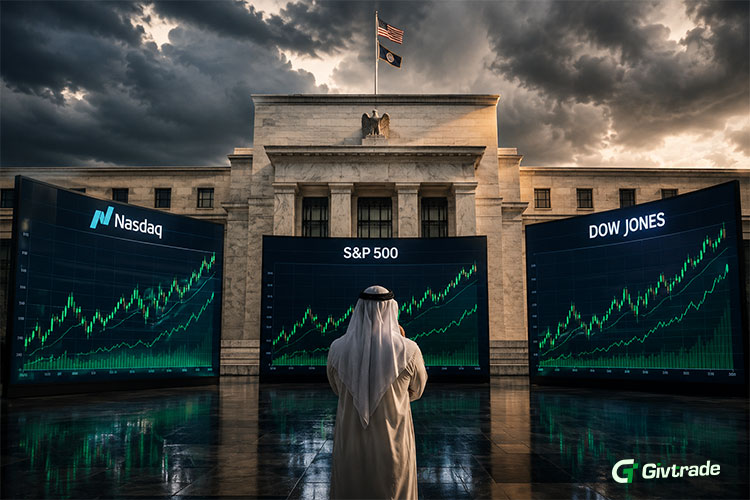
Table of Contents
1. The FOMC Calendar: What GCC Traders Mark in Advance
2. Why NASDAQ Reacts Most: The Discount Rate Mechanism Explained
3. Decision vs Press Conference: Which One Actually Moves Markets
4. The Three FOMC Outcomes and How Each Index Responds
5. “Don't Fight the Fed”: What This Actually Means in Practice
6. How Experienced GCC Traders Prepare for FOMC Days
7. Frequently Asked Questions
8. The Bottom Line
No scheduled event moves US equity indices more reliably than a Federal Reserve interest rate decision. When the Fed raises rates or signals more hikes ahead, indices typically fall —NASDAQ falls hardest. When the Fed cuts rates or signals cuts, indicestypically rally — NASDAQ leads the rally too. FOMC decisions release approximately eight times a year at 9:00 PM UAE time (8:00 PM Saudi and Kuwait time), and the Fed Chair's press conference 30 minutes later often moves index CFDs more than the decisionitself. For GCC traders holding US30, USTEC, or US500 positions, understand ingthis mechanism is not optional background — it is the single most important recurring event on the trading calendar.
The FOMC Calendar: What GCC Traders Mark in Advance
The Federal Open Market Committee meets eight times per year, roughly every six weeks, with dates published a year in advance. Each meeting follows the same two-day structure,decisions released on day two.
Both events land at a fully accessible evening hour for GCC traders — no overnight monitoring required,unlike US earnings which often release after midnight Gulf time. GivTrade's economic calendar marks each FOMC date months in advance.
Why NASDAQ Reacts Most: The Discount Rate Mechanism Explained
NASDAQ 100 is the most Fed-sensitive of the three major US indices, and the reason is a specific valuation mechanic, not just sentiment. Technology companies are valued heavilyon expected future earnings — cash flows that may be five or ten years out. Tovalue those future earnings today, markets apply a discount rate, and that discount rate is built directly from prevailing interest rates.
When the Fed raises rates, the discount rate used to value future earnings rises too — which mechanically reduces the present value of a company expected to generate most of its profityears from now. A company like NVIDIA or Tesla, priced heavily on growth expected well into the future, takes a proportionally larger valuation hit thana bank or industrial company already generating most of its profit today. This is why hawkish Fed rhetoric consistently sends NASDAQ underperforming the Dow,and why dovish pivots send NASDAQ leading the rally.
The Dow Jones, weighted toward industrials, financials, and consumer staples, is the least sensitive to this mechanism — these companies are valued more on current earnings than distant future growth. The S&P 500 sits in between, since it holds both types of companies. GCC traders rotating between US30,USTEC, and US500 CFDs based on the prevailing Fed narrative are, in effect,trading this discount-rate sensitivity difference directly.
Decision vs Press Conference: Which One Actually Moves Markets
A pattern that surprises newer GCC index traders: the rate decision itself, released at 9:00 PM UAE time, is frequently already priced in. Markets assign probabilities to Fed outcomes well in advance using futures pricing, so when the Fed delivers exactly what wasexpected, indices often barely move on the decision alone.
The Fed Chair's press conference 30 minutes later is where the real volatility typically occurs. Traders parse every word of the prepared statement and every answer in the Q&A for forward guidance — hints about the pace of future hikes or cuts, comments oni nflation persistence, or any deviation from the previous meeting's tone. Asingle phrase change (“data dependent” versus “patient,” for example) has historically moved NASDAQ 1–2% within minutes. GCC traders who close their charts at 9:05 PM after the decision and miss the press conference are skipping the part of the event that most often determines the actual move.
The Three FOMC Outcomes and How Each Index Responds
The practical implication: traders building a NASDAQ position around an expected dovish pivot are taking the highest-reward, highest-risk expression of that view. Traders who want the same directional bet with less single-session volatility often use S&P 500 instead.
“Don't Fight the Fed”: What This Actually Means in Practice
“Don't fight the Fed” is one ofthe most repeated phrases in US equity trading, and it surfaces consistently among GCC traders who have built positive track records in index CFDs. The principle is simple: when the Fed is in a clear rate-hiking cycle, betting on a sustained NASDAQ rally against that backdrop is betting against the singlel argest institutional flow driver in the market. When the Fed pivots to cuts,betting against a rally is the same mistake in reverse.
This does not mean every single session moves with the Fed's direction — short-term pull backs happen within hawkish cycles and rallies pause within dovish ones. It means the dominant multi-week trend tends to align with the prevailing Fed stance, and traders who position against that prevailing direction based on a single bullish earnings report or technical setup consistently find themselves on the losing side of much larger capital flows when the next FOMC reinforces the existing stance.
How Experienced GCC Traders Prepare for FOMC Days
• Check the rate probability pricing beforehand. Futures-implied probabilities for the FOMC outcome are available days in advance through GivTrade's market reports— knowing what is already priced in is the foundation for judging whether the actual decision is a surprise.
• Reduce position size before 9:00 PM UAE time. Gulftraders who hold index CFD positionsthrough FOMC days commonly reduce size ahead of the release, since the combineddecision-plus-press-conference window can produce moves that exceed a normalsession's range within 30–60 minutes.
• Stay through the press conference, not just the decision. As covered above, the 9:30 PM commentary frequently matters more than the 9:00 PM number. Closing positions or stepping away right after the decision misses the part of the event most likely to determine direction.
• Watch VIX alongside the index. A VIX reading above 20–25 heading into an FOMC day signals elevated uncertainty and historically larger post-meeting moves in either direction.
• Use the economic calendar as the starting point every cycle. GivTrade's economic calendar marks each of the eight annual FOMC dates well in advance, removing any risk of being caught unaware.
Frequently Asked Questions
What time does the Fed announce interest rate decisions in UAE time?
FOMC rate decisions release at 9:00 PM UAE time (8:00 PM Saudi Arabia and Kuwait time), approximately eight times per year. The Fed Chair's press conference follows 30 minutes later at 9:30 PM UAE time (8:30 PM AST) and frequently produces more market movement than the decision itself. GivTrade's economic calendar marks each date in advance.
Why does NASDAQ react more to Fed decisions than the Dow Jones?
NASDAQ is dominated by technology companies valued heavily on future earnings. Higher interest rates raise the discount rate used to value those future cash flows, mechanically reducing present valuations more for growth-heavy tech stocks than for industrialsor banks already generating most of their profit today. This is why hawkish Fed signals consistently hit NASDAQ hardest, and dovish pivots send it leading the rally.
Does the Fed rate decision or the press conference move markets more?
Often the press conference. The rate decision itself is frequently already priced in through futures markets before the announcement. The Fed Chair's subsequent press conference, where forward guidance and inflation commentary are parsed word by word, has historically produced larger NASDAQ moves than the decision release 30 minutes earlier.
What does “don't fight the Fed” mean for index traders?
It means the dominant multi-week trend in US indices tends to align with the prevailing Fed policy direction —rallying during cutting cycles, struggling during hiking cycles. GCC traders who position against this prevailing direction based on short-term signals consistently find themselves working against far larger institutional capital flows once the next FOMC reinforces the existing stance.
How should GCC traders size index positions around FOMC days?
A common pattern among experienced Gulf traders is reducing position size on index CFDs ahead of the 9:00 PM UAE time decision, since the combined decision-and-press-conference window can move NASDAQ, S&P 500 and Dow significantly within an hour. Checking VIX levels and futures-implied rate probabilities beforehand, available through market reports, helps calibrate expected volatility.
The Bottom Line
For GCC traders holding US30, USTEC, or US500 positions, FOMC days are the single most important recurring event on the calendar — eight times a year, always landing in an accessible Gulf evening window. NASDAQ' sheightened sensitivity comes from a specific valuation mechanic, not just sentiment, and the press conference frequently matters more than the headline decision. The traders who manage this best check rate probabilities in advance,size down ahead of the release, and stay through the full event rather than reacting only to the first number.
Mark every FOMC date onGivTrade's economic calendar, review market reports for rate-probability context, and explore index CFD account options— including swap-free configurations for multi-day positions held around Fed policy shifts.
Risk Warning: Trading index CFDs and other Contracts forDifference on margin carries a high level of risk and may not be suitable forall investors. Retail clients could sustain a total loss of deposited funds.This article is for informational and educational purposes only and does not constitute investment advice. GivTrade Mauritius, registration No. 197387, is authorized and regulated by the Financial Services Commission (FSC) License No.GB22201329.