
What Is a Hawkish vs Dovish Fed and What Does It Mean for Your Trades? (2026)
Every time the Federal Reserve speaks, markets move. The direction of that move depends on one thing: whether the tone is hawkish or dovish.
These two words appear in every piece of financial market commentary - and are misunderstood or only vaguely understood by a significant proportion of GCC traders who use them. Knowing exactly what hawkish and dovish mean, how to identify which one the Fed is signalling, and what each stance does to USD pairs, gold, and oil is foundational knowledge for anyone trading in a market driven by US monetary policy.
With the September 2026 FOMC meeting concluding this week, the distinction between a hawkish hold and a dovish hold - both of which keep rates unchanged - is the difference that determines whether EUR/USD rises or falls, and whether gold extends its recent move or reverses.
The Core Definitions
Hawkish describes a monetary policy stance focused on controlling inflation, typically through higher interest rates or a signal that rates will stay elevated for longer. A hawk prioritises price stability over economic growth. When the Fed is hawkish, it is either raising rates, signalling that it will raise them, or signalling that it will not cut them as soon as markets expected.
Dovish describes a monetary policy stance focused on supporting economic growth and employment, typically through lower interest rates or signals that cuts are coming. A dove prioritises growth and jobs over inflation control. When the Fed is dovish, it is either cutting rates, signalling that cuts are coming sooner than expected, or signalling that the hiking cycle is definitively over.
The terms come from the behaviour of birds - hawks are aggressive, doves are peaceful. In monetary policy, a hawkish Fed is aggressive toward inflation. A dovish Fed is accommodative toward the economy.
Why the Distinction Matters for GCC Traders
For UAE and GCC traders, the hawkish-dovish distinction matters because it directly determines the direction of the US dollar - and the dollar is the denominator or numerator in virtually every instrument GCC traders touch.
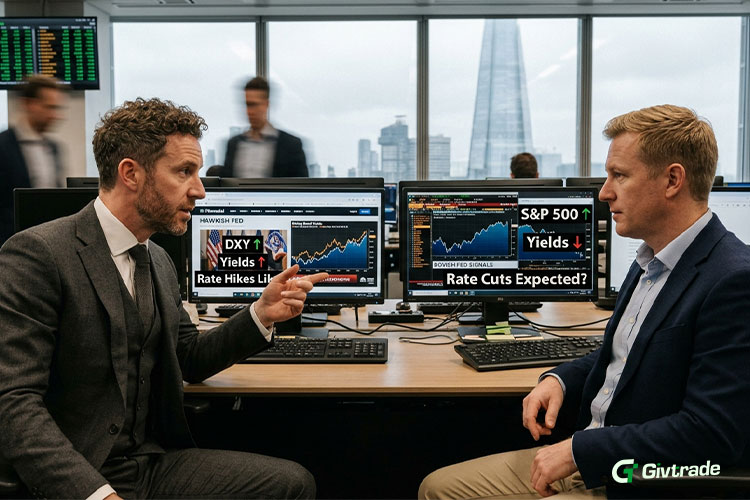
A hawkish Fed raises or sustains higher US interest rates. Higher rates mean higher yields on USD-denominated assets - bonds, savings, treasuries. Global capital flows into the US to capture those higher yields, which means more demand for USD, which strengthens the dollar. EUR/USD falls. GBP/USD falls. Gold - which earns no yield and competes with yield-bearing assets - faces headwinds. Oil, priced in dollars, becomes more expensive for non-dollar buyers, reducing demand and putting downward pressure on price.
A dovish Fed cuts or signals cuts to US interest rates. Lower rates reduce the yield advantage of USD assets. Capital flows elsewhere in search of better returns, reducing demand for the dollar. EUR/USD rises. GBP/USD rises. Gold benefits as the opportunity cost of holding a non-yielding asset falls. Oil gets a tailwind as the dollar weakens.
How to Identify Hawkish vs Dovish Signals
The Fed communicates its stance through four main channels - and experienced GCC traders read all four, not just the rate decision itself.
The rate decision. A rate hike is hawkish. A rate cut is dovish. A hold is neutral on its own - but the surrounding signals determine whether a hold is hawkish or dovish in practice.
The FOMC statement. The statement contains specific language that markets parse for shifts. Phrases like "inflation remains elevated," "the Committee remains attentive to upside inflation risks," or "further firming may be appropriate" are hawkish signals. Phrases like "inflation has eased substantially," "the risks are now more balanced," or "the Committee will monitor incoming data" lean dovish. The shift in language between one meeting and the next is often more market-moving than the rate decision itself.
The dot plot. The Summary of Economic Projections - released at four of the eight annual meetings - includes the "dot plot," which shows each Committee member's projection for where the federal funds rate will be at year-end and in future years. A dot plot that shows fewer cuts than markets expected is hawkish. One that shows more cuts is dovish. The September 2026 dot plot is one of the most closely watched of the year given the current inflation data sequence.
The press conference. Fed Chair Kevin Warsh's language during the post-decision press conference frequently determines the sustained market direction after the initial decision spike. Phrases emphasising data dependence and patience are typically read as neutral to dovish. Phrases emphasising vigilance on inflation or the possibility of further action are read as hawkish. GCC traders who only trade the 9:00 PM UAE time decision and miss the 9:30 PM press conference consistently describe being caught off guard by the second, larger market move.
The Hawkish Hold vs The Dovish Hold
The most nuanced distinction - and the one that trips up GCC traders most frequently - is when the Fed holds rates unchanged but the tone of the statement and press conference is either hawkish or dovish.
A hawkish hold keeps rates unchanged but signals that cuts are further away than markets expected, or that another hike remains possible. The dollar typically strengthens on a hawkish hold, and gold sells off, even though the rate itself did not move. This is because markets trade expectations of future rates, not just the current rate.
A dovish hold keeps rates unchanged but signals that cuts are coming sooner than markets expected, or that the tightening cycle is clearly over. The dollar typically weakens on a dovish hold, and gold rallies, again because expectations shift even without an actual rate change.
The September 2026 FOMC meeting - concluding this week - is expected to be a hold. Whether it reads as hawkish or dovish depends on how the statement and press conference characterise the recent inflation data sequence: PPI, CPI, and Core PCE all printed this month ahead of the meeting. A Committee that views those prints as confirming disinflation is dovish. One that views them as insufficient evidence of sustained progress is hawkish.
Hawkish and Dovish Beyond the Fed
The hawkish-dovish framework applies to every major central bank - not just the Federal Reserve. The European Central Bank, Bank of England, Bank of Japan, and Reserve Bank of Australia all communicate policy stances in the same terms.
For GCC traders who follow EUR/USD, the relative stance of the Fed versus the ECB is what matters - not either bank in isolation. If the Fed is dovish and the ECB is hawkish simultaneously, EUR/USD gets a double tailwind from both sides of the pair. This relative central bank divergence is one of the most powerful drivers of sustained directional moves in major currency pairs - and understanding whether each bank is hawkish or dovish is the starting point for reading that divergence correctly. For the full breakdown of how major central banks set policy and what their decisions mean for GCC traders, see our central banks and currency values guide.
The GivTrade Take
Hawkish and dovish are not abstract labels - they are the directional signals that precede every significant USD move in the forex market. A GCC trader who can identify in real time whether a Fed statement is reading hawkish or dovish has a meaningful advantage over one who waits for financial media to summarise it 30 minutes later.
The discipline is building the habit of reading the statement and press conference directly rather than waiting for interpretation. The FOMC statement is 400-600 words - it takes three minutes to read. The press conference runs 45 minutes - the first 15 contain the most market-relevant language. For the full preparation framework around FOMC meetings, our FOMC meeting guide covers exactly how to prepare and position around each decision.
Frequently Asked Questions
What does hawkish mean in forex trading?
A hawkish central bank stance prioritises controlling inflation through higher or sustained elevated interest rates. A hawkish Fed typically strengthens the USD as higher rates attract capital seeking better yields.
What does dovish mean in forex trading?
A dovish central bank stance prioritises economic growth through lower interest rates or signals that cuts are coming. A dovish Fed typically weakens the USD as lower rates reduce the yield advantage of dollar-denominated assets.
Can a rate hold be hawkish or dovish?
Yes - and this is one of the most important distinctions in forex trading. A hold accompanied by language suggesting cuts are further away is hawkish. A hold accompanied by language suggesting cuts are coming sooner is dovish. The rate itself did not move, but market expectations of future rates did.
How do I know if the Fed is being hawkish or dovish?
Read the FOMC statement for key phrase changes, watch the dot plot at quarterly meetings for shifts in rate projections, and listen to the press conference for the Chair's language on inflation progress and the future rate path. Each of these signals combines to give the full picture of the Fed's stance.
Does the hawkish-dovish framework apply to other central banks?
Yes - it applies to every major central bank including the ECB, Bank of England, Bank of Japan, and others. For GCC traders, the relative stance of two central banks - one hawkish and one dovish - is what drives sustained directional moves in currency pairs.
Risk Warning: Trading forex and Contracts for Difference (CFDs) on margin carries a high level of risk. Retail clients could sustain a total loss of deposited funds. This article is for informational and educational purposes only and does not constitute investment advice. GivTrade Financial Services L.L.C S.O.C, CMA licence #20200000367. GivTrade Mauritius, registration No. 197387, is authorized and regulated by the Financial Services Commission (FSC) License No. GB22201329.