

Hawkish vs Dovish: What Fed Language Means for UAE & GCC Traders
Hawkish vs Dovish: What Fed Language Means for UAE & GCC Traders
Table of Contents
1. Hawkish vs Dovish: The Direct Answer
2. Why Central Bank Language Moves Forex Markets
3. The Federal Reserve: How and When It Communicates
4. Hawkish Language: Words, Phrases, and Market Reactions
5. Dovish Language: Words, Phrases, and Market Reactions
6. How FOMC Decisions Are Scheduled — and UAE Times
7. Beyond the Fed: ECB, BOE, and BOJ for GCC Traders
8. Reading a Fed Statement: A Practical Framework
9. Frequently Asked Questions
10. The Bottom Line
Hawkish means a central bank favours higher interest rates to control inflation — this strengthens the currency. Dovish means a central bank favours lower interest rates to support economic growth — this weakens the currency. For traders in UAE, Saudi Arabia, Kuwait, Qatar, Bahrain, and Oman, understanding these two terms is essential because the Federal Reserve (Fed), European Central Bank (ECB), and Bank of England (BOE) communicate their rate intentions through carefully chosen language weeks before any actual decision is made — and the market reprices EUR/USD, GBP/USD, gold, and other instruments the moment that language shifts, often more sharply than on the rate decision itself.
Hawkish vs Dovish: The Direct Answer
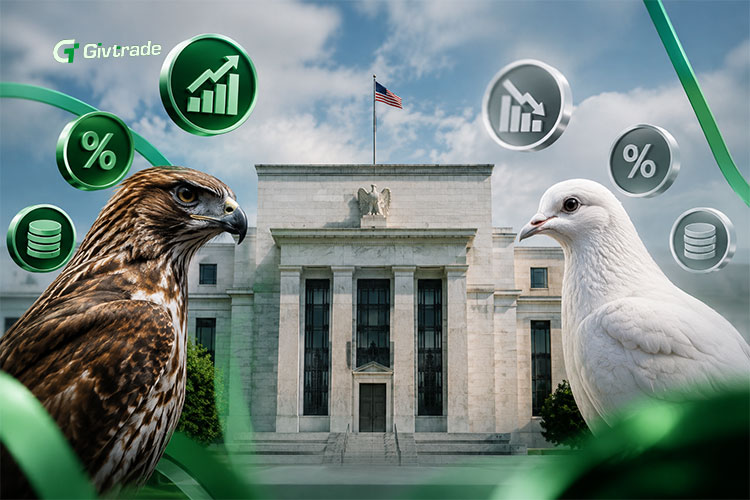
The terms come from the behaviour of the birds: a hawk is aggressive, a dove is peaceful. Applied to central bank policy:
There is also a spectrum between the two: 'neutral' or 'balanced' language signals that the central bank has no strong bias in either direction, and 'less hawkish than expected' (sometimes called a 'dovish hike') can actually weaken a currency even when a rate hike just occurred — because the market was positioned for an even more aggressive signal.
Why Central Bank Language Moves Forex Markets
Interest rates are the single most powerful driver of currency values. Higher rates attract foreign capital seeking better returns on that currency's assets — bonds, savings accounts, money market funds. This capital inflow increases demand for the currency and pushes it higher. Lower rates do the opposite.
The market does not wait for the actual rate decision to price this in. Investors and trading algorithms constantly estimate the probability of future rate moves — called rate expectations or market pricing — based on every piece of economic data and every word from central bank officials. When those expectations shift, currency prices shift immediately.
This is why a speech by the Fed Chair at 9:00 PM UAE time on a Wednesday can move EUR/USD 80 pips in a single hour with no rate change, no economic data release, and no news — only a subtle shift in the language used to describe the inflation outlook. The words are the forward guidance; the market trades the guidance, not just the decision.
The data that feeds these expectations — CPI, NFP — has already been covered in the CPI guide and NFP guide. Hawkish and dovish language is how central banks respond to that data in words — and the market reacts to those words in real time.
The Federal Reserve: How and When It Communicates
The Federal Reserve is the world's most market-influencing central bank because the US dollar is involved in approximately 85% of all global forex transactions. The Fed communicates its policy stance through several channels:
Of these, the most market-moving in real time are the FOMC Statement and the Chair's Press Conference. The dot plot is particularly powerful because it shows where the Fed expects rates to be in 12, 24, and 36 months — a shift in the dot plot median is treated by the market as a major shift in the rate outlook, often moving EUR/USD 100+ pips within minutes of release.
Hawkish Language: Words, Phrases, and Market Reactions
Hawkish language signals that the central bank is concerned about inflation and is willing to raise rates or keep them elevated. Learning to recognise these phrases in real time — during a live Fed statement or press conference — is a practical skill for GCC traders active during FOMC windows.
The typical market reaction to a clearly hawkish FOMC statement: EUR/USD falls 40–100 pips within the first 30 minutes of the statement release at 2:00 AM UAE. If the press conference (2:30 AM) reinforces the message, the move extends further through the early morning UAE hours.
Dovish Language: Words, Phrases, and Market Reactions
Dovish language signals that the central bank is concerned about economic growth or employment, and is open to rate cuts or has already begun cutting. It is the opposite of hawkish — and it weakens the currency immediately as rate cut expectations are repriced into asset values.
The 'less hawkish than expected' scenario is worth understanding separately: if the market expected a hawkish hold (rates unchanged but strongly hawkish language) and instead received a neutral hold (rates unchanged, balanced language), EUR/USD can rally 50–80 pips even though rates did not change and no rate cuts were signalled — purely because the expected hawkishness did not materialise.
How FOMC Decisions Are Scheduled — and UAE Times
The FOMC meets eight times per year on a fixed schedule. The decision and press conference happen on the second day of each two-day meeting. GCC traders can mark every FOMC date on the economic calendar at the start of each year — the full calendar is published by the Fed in January.
The late UAE timing of FOMC decisions (2:00 AM) means most GCC traders do not trade live through the announcement. The more common approach among UAE traders: review any open positions before midnight, set appropriate stop-losses, and assess the market reaction the following morning. Those who do trade live through FOMC consistently describe reducing position size to a fraction of their normal trade size given the potential for 100–150 pip moves in the first 30 minutes.
Beyond the Fed: ECB, BOE, and BOJ for GCC Traders
While the Fed drives USD pairs most powerfully, GCC traders active in EUR/USD and GBP/USD also follow the ECB (European Central Bank) and BOE (Bank of England). Their hawkish/dovish language has the same effect on their respective currencies:
A practical note on the ECB and BOE: their decisions fall during the London session at approximately 3:00–3:30 PM UAE — highly accessible for GCC traders. An ECB decision that turns more hawkish than expected (e.g. Lagarde signals fewer rate cuts ahead) strengthens EUR and moves EUR/USD upward even as it has nothing to do with USD directly. This is a common source of confusion for newer GCC traders who expect only the Fed to move EUR/USD.
Reading a Fed Statement: A Practical Framework
Fed statements are typically 400–600 words and follow a consistent structure. Experienced GCC traders focus on three specific elements rather than reading every word:
1. The Rate Decision Line
The first substantive paragraph states what was decided: 'The Committee decided to raise/lower/maintain the target range for the federal funds rate.' This is the headline — but it is rarely a surprise because the market has usually priced in the decision weeks in advance. A surprise here (unexpected hike or cut) produces the largest possible market reaction.
2. The Forward Guidance Language
The key paragraph usually begins with something like 'The Committee anticipates...' or 'In determining the extent of...' This is where hawkish vs dovish language is most concentrated. Changes from the prior statement — even a single word like changing 'further policy firming' to 'any additional policy firming' — are what professional traders and algorithms are trained to detect instantly. Having the prior statement open for direct comparison is the single most practical approach during a live FOMC.
3. The Vote Split
At the end of the statement is the voting record. A unanimous decision (e.g. 12-0 for a hold) signals broad consensus. A split vote (e.g. 10-2 with two dissents for a hike) signals internal disagreement and often produces a more volatile reaction because it suggests the path forward is contested within the committee itself.
Frequently Asked Questions
What does hawkish mean in forex?
Hawkish in forex means a central bank is inclined toward higher interest rates to control inflation. When the Federal Reserve uses hawkish language, it signals that rate hikes are possible or that current high rates will be maintained for longer. This increases the expected return on USD-denominated assets, attracting foreign capital and strengthening the dollar. EUR/USD typically falls, and gold typically falls, on hawkish Fed communication.
What does dovish mean in forex?
Dovish in forex means a central bank is inclined toward lower interest rates to support economic growth or employment. Dovish Fed language signals that rate cuts are coming or that the pace of rate increases is slowing. This reduces the expected return on USD-denominated assets, weakening the dollar. EUR/USD typically rises, and gold typically rises, on dovish Fed communication.
Why does Fed language matter more than the actual rate decision?
Because the market prices future expectations, not current facts. By the time the Fed announces a rate decision, that decision is usually 90–100% priced in based on prior statements, economic data, and Fed speeches. What is not fully priced in is the language about what comes next — specifically, whether future hikes are more or less likely than the market currently expects. A 25bps hike paired with unexpected dovish language about pausing future hikes can actually weaken USD despite the rate increase, because the market was priced for more hikes ahead.
When is the next FOMC decision — what time in UAE?
FOMC decisions are released at 2:00 AM UAE time (US summer) or 3:00 AM UAE time (US winter), eight times per year. The exact dates are published by the Federal Reserve in January of each year and are listed with 'High Impact' ratings on the economic calendar. The Chair's press conference follows 30 minutes later at 2:30 AM UAE (summer) or 3:30 AM UAE (winter).
Do ECB and BOE decisions also move EUR/USD?
Yes — an ECB decision affects the EUR side of EUR/USD directly. A hawkish ECB (signalling higher eurozone rates) strengthens EUR and pushes EUR/USD upward even when the Fed has not changed policy. ECB and BOE decisions fall at approximately 3:00–3:15 PM UAE time — during the London session, making them highly accessible for GCC traders. UAE-based traders following EUR/USD should monitor ECB meeting dates with the same attention as Fed dates.
The Bottom Line
Hawkish means higher rates ahead — buy USD, sell EUR/USD, expect gold to fall. Dovish means lower rates ahead — sell USD, buy EUR/USD, expect gold to rise. The market reacts to central bank language in real time because rate expectations are the primary driver of currency values, and language is the primary channel through which central banks signal those expectations weeks before any actual decision.
For traders in UAE, Saudi Arabia, Kuwait, Qatar, Bahrain, and Oman, the practical application is straightforward: mark FOMC, ECB, and BOE dates on the calendar at the start of each month, read the prior statement before the new one is released so you can identify what changed, and reduce position size around the announcement regardless of your directional view. The combination of unexpected language with leveraged positions is one of the most reliable causes of outsized single-session losses among GCC traders — and one of the most avoidable.
Risk Warning: Trading Forex and Contracts for Difference (CFDs) on margin carries a high level of risk and may not be suitable for all investors. Retail clients could sustain a total loss of deposited funds. This article is for informational and educational purposes only and does not constitute investment advice. GivTrade Mauritius, registration No. 197387, is authorized and regulated by the Financial Services Commission (FSC) License No. GB22201329.


