
Safe Havens in a Crisis: Gold, Yen & Dollar When Markets Fall | GCC Guide (2026)
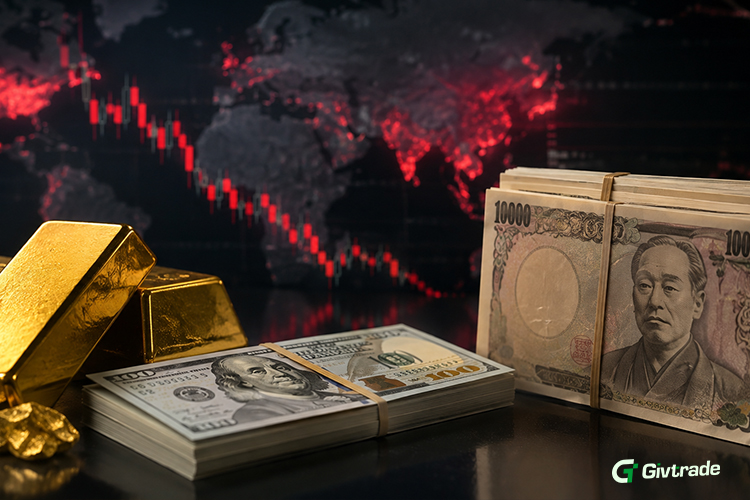
Table of Contents
1. What Is a Safe Haven Asset?
2. Gold: The Primary Crisis Asset and Why It Rises
3. The Japanese Yen: The Carry Trade Unwind Mechanism
4. The US Dollar: A Conditional Safe Haven
5. How the Three Move Together — and When They Diverge
6. 2026 Case Study: The Iran Conflict and the Safe Haven Response
7. What Safe Haven Moves Mean for GCC Oil and Equity Traders
8. Frequently Asked Questions
9. The Bottom Line
Safe haven assets are instruments that investors buy when fear dominates markets — they hold their value or rise when stocks, oil, and riskier assets fall. The three most consistent safe havens in global markets are gold (XAU/USD), the Japanese yen (JPY), and — conditionally — the US dollar (USD). Each rises through a different mechanism: gold through direct demand for a store of value, the yen through the unwinding of the global carry trade, and the dollar through capital flight into US Treasury markets. For UAE, Saudi Arabia, Kuwait, Qatar, Bahrain and Oman traders who hold gold, forex, or oil CFDs, understanding how these three safe haven assets move during a crisis — and critically, when they diverge from each other — is what separates prepared positioning from reactive confusion when the next risk event arrives.
What Is a Safe Haven Asset?
A safe haven asset is one that investors move capital into during periods of market stress, geopolitical fear, or economic uncertainty. The defining characteristics are:
Safe havens are not permanent — they are contextual. An asset that is a safe haven in one crisis may not be in another, depending on the specific fear driving the market. Gold works as a safe haven against almost every type of crisis. The yen works primarily when the crisis triggers a risk-off carry trade unwind. The dollar works as a safe haven against non-US crises, but can itself be the source of fear in a US fiscal or confidence crisis.
Gold: The Primary Crisis Asset and Why It Rises
Gold is the most universal and consistent safe haven across all crisis types. Its reliability stems from several structural properties that no other asset shares: it has no counterparty (owning gold is owning gold, not a promise from an institution), it has maintained value across thousands of years and dozens of currency collapses, it is recognized globally as a store of value, and its supply is constrained by geology rather than central bank policy.
During a crisis, gold rises through multiple simultaneous demand channels:
• Direct safe-haven buying: investors selling equities, bonds, and riskier assets directly buy gold as a store of value.
• USD weakness: crises that weaken the dollar (geopolitical events that undermine US credibility, fiscal crises) directly push gold higher because gold is priced in dollars — a weaker dollar makes gold cheaper for non-dollar buyers, increasing demand.
• Real yield compression: crises that force central banks toward rate cuts reduce real yields on bonds. Gold, which pays no interest, becomes relatively more attractive when the competing return from holding bonds falls.
In 2026, gold hit an all-time high of $5,600 per troy ounce on January 29, driven by the Iran-related geopolitical crisis of early 2026 — all three of these channels firing simultaneously. Geopolitical fear (safe-haven buying), USD weakness (geopolitical uncertainty undermining dollar confidence), and rate cut expectations (reducing real yields) all aligned to produce the largest single gold rally in modern market history.
The Japanese Yen: The Carry Trade Unwind Mechanism
The yen’s safe haven status is not intuitive to most beginners — Japan has high debt, slow growth, and an aging population. The yen’s crisis behaviour comes from an entirely different mechanism: the global carry trade. For decades, institutional investors borrowed yen at near-zero Japanese interest rates and invested in higher-yielding currencies and assets globally. In mid-2026, with the Bank of Japan’s rate at 1.00%, this carry is worth approximately 2.75% per year against a US 3.75% rate.
When a crisis occurs — particularly a global risk-off event like an equity market crash, a financial system stress, or a sudden deterioration in growth outlook — carry trade positions are unwound rapidly. Institutional investors sell the high-yielding assets they bought with borrowed yen and buy back the yen they borrowed. This sudden, large-scale demand for yen causes the currency to strengthen sharply, regardless of Japan’s own economic fundamentals. The July 2024 crash from USD/JPY 161 to 141.70 in three weeks is the most recent major illustration: BoJ rate hike + weak US jobs data triggered a carry unwind that strengthened yen by 12% in three weeks.
For GCC traders: the yen’s safe-haven strengthening (USD/JPY falling) is therefore a crisis signal and a carry unwind signal simultaneously. When USD/JPY falls sharply, it typically means risk appetite is collapsing globally — which is also bearish for equities, commodity demand, and often bullish for gold. A rapidly falling USD/JPY is one of the most reliable real-time indicators that a risk-off environment is becoming severe.
The US Dollar: A Conditional Safe Haven
The USD’s safe haven status is the most conditional of the three. The dollar rises as a safe haven in specific crisis types: those that trigger flight to US Treasury markets (where capital seeks the deepest, most liquid bond market in the world), those that cause a global “cash grab” where dollars are needed to cover margin calls and redemptions, and those where the specific fear is located outside the US.
But the dollar can weaken — or even fall — during crises where the US itself is the source of concern: a US fiscal credibility crisis, a Federal Reserve policy error, or a geopolitical event that undermines US global influence. The January 2026 Iran conflict is a case where the geopolitical event was simultaneously bearish for the dollar (US military involvement raised fiscal concerns and geopolitical uncertainty about US stability) and bullish for gold (safe-haven demand). Both gold and the yen rose; the dollar’s safe haven status was complicated rather than straightforward. The relationship between the dollar and crisis behaviour is explored in the DXY and oil correlation guide.
How the Three Move Together — and When They Diverge
The key insight from this table: gold and the yen tend to move in the same direction (up) during almost every crisis type. The dollar is the divergence variable — its behaviour depends on whether the US is inside or outside the crisis. The most consistent safe haven call for GCC traders, across all crisis types, is therefore: when fear spikes, gold and yen typically both rise, while the dollar’s direction requires further context.
2026 Case Study: The Iran Conflict and the Safe Haven Response
The geopolitical events of early 2026 — US and Israeli strikes on Iran, followed by Iran’s Strait of Hormuz closure declaration and subsequent oil supply disruption — produced one of the most visible safe haven episodes in recent years, with specific lessons for GCC traders. The full supply shock context is covered in the Strait of Hormuz guide, but the safe haven flow pattern during the same period deserves standalone analysis:
• Gold surged to a historic ATH of $5,600 on January 29, 2026. All three safe haven channels fired simultaneously: direct fear-driven buying, USD weakness from US geopolitical involvement, and Fed rate cut expectations from the economic uncertainty. The move from roughly $3,000 levels to $5,600 in approximately four weeks represented a near-doubling of the gold price.
• Silver followed gold but moved further in percentage terms. Silver reached $121.67 on the same date, up from roughly $35-40 at end-2025 — a 200%+ move. Silver’s amplified safe-haven response reflects its smaller market size and dual industrial-safe haven demand structure.
• The yen initially strengthened as carry trades partially unwound. USD/JPY came under pressure in early 2026 as geopolitical uncertainty added to the existing carry trade compression pressure from BoJ rate hikes.
• The dollar was mixed, not purely bullish. Unlike a typical EM crisis (where dollars are unambiguously sought), the US involvement in the Iran conflict introduced doubt about whether the US was inside or outside the crisis — limiting the dollar’s traditional safe haven response.
The January 2026 episode confirmed that for Middle East-specific geopolitical crises, gold and silver are the clearest safe haven trades — not the dollar — because US military involvement complicates the dollar’s role while simultaneously strengthening the case for non-counterparty stores of value.
What Safe Haven Moves Mean for GCC Oil and Equity Traders
For GCC traders who primarily trade oil, gold, and indices rather than forex, safe haven flows have specific cross-market implications that often catch beginners off-guard:
• A gold rally does not automatically mean oil rallies. In a geopolitical supply disruption (Hormuz, Red Sea), both can rise simultaneously. But in a demand-driven risk-off episode (recession fear, equity crash), gold typically rises while oil falls, because the same fear that drives safe-haven gold buying also prices in lower economic activity and therefore lower oil demand.
• A falling USD/JPY (yen strengthening) is a risk-off signal for all risk assets. When institutional carry trade positions unwind and yen strengthens sharply, equities, oil, and riskier assets typically fall simultaneously. GCC traders who notice USD/JPY falling sharply in their MetaTrader 5 alongside their oil or equity positions should treat it as a warning signal for those positions, not an isolated forex event.
• Gold can be used as a hedge for GCC oil positions in specific scenarios. In a geopolitical crisis that simultaneously threatens oil supply and drives safe-haven demand (Hormuz, OPEC emergency), both oil and gold may rise together. But in a pure demand destruction scenario, gold hedges oil’s downside because when oil falls on economic weakness, gold rises on safety demand. This cross-instrument hedging logic is used by experienced GCC multi-market traders, not just pure commodity traders.
• The safe haven premium fades after the peak fear moment. After the initial crisis surge, gold and yen positions typically enter a partial retrace phase as markets assess the actual (not feared) magnitude of the event. The January 2026 gold surge to $5,600 was followed by a pullback to the $4,000–4,200 range by July 2026 — not because gold lost its safe haven status, but because the peak fear moment passed and markets recalibrated to the sustained (but not accelerating) risk environment.
Frequently Asked Questions
What are the main safe haven assets in financial markets?
The three most consistent safe haven assets in global markets are gold (XAU/USD), the Japanese yen (JPY), and conditionally the US dollar (USD). Gold rises through direct store-of-value demand, limited counterparty risk, and USD weakness. The yen rises through carry trade unwinding as institutional investors close yen-funded positions and buy back JPY. The USD rises during crises outside the US as capital seeks US Treasury liquidity, but can fall during US-specific crises.
Why does gold rise when markets fall?
Gold rises when markets fall through three simultaneous mechanisms: direct safe-haven buying from investors selling riskier assets, USD weakness (which makes gold cheaper for non-dollar buyers and increases demand), and real yield compression (as central banks cut rates in response to economic stress, bonds become less competitive, making gold more attractive). In 2026, all three fired simultaneously during the Iran conflict, driving gold to an all-time high of $5,600 on January 29, 2026.
Why does the Japanese yen strengthen during a crisis?
The yen’s crisis behaviour is driven by carry trade unwinding, not Japan’s economic fundamentals. Institutional investors borrow yen at Japan’s low interest rates and invest in higher-yielding global assets. When a risk-off crisis hits, those investors sell their global positions and buy back yen to repay their borrowings. This sudden, large-scale yen demand causes USD/JPY to fall sharply — the yen strengthens — regardless of Japanese economic conditions.
Is the US dollar always a safe haven?
No. The USD is a conditional safe haven that works in crises outside the US (EM crises, geopolitical events that don’t involve the US directly). During crises where the US itself is the source of concern — US fiscal credibility issues, geopolitical events involving US military action, or Federal Reserve policy errors — the dollar can fall even as gold and the yen rise. The January 2026 Iran conflict showed this: gold and yen both rose while the dollar’s safe haven response was limited by US military involvement in the crisis.
How do safe haven flows affect oil prices for GCC traders?
Safe haven flows and oil prices are not consistently correlated. In geopolitical supply disruptions (Hormuz closure, Red Sea attacks), both oil and gold can rise simultaneously as supply fear and safe-haven demand align. In demand-driven risk-off events (recession fear, equity crash), oil typically falls while gold rises — because the same economic weakness that drives safe-haven gold buying also reduces the demand outlook for oil. GCC traders who track gold’s safe haven moves alongside their oil positions can use the divergence or convergence pattern as a signal for whether the crisis is supply-driven or demand-driven.
The Bottom Line
In every crisis, the starting question for UAE, Saudi Arabia, Kuwait, Qatar, Bahrain and Oman traders is: gold and yen typically rise, dollar direction depends on context, and oil can go either way depending on whether the fear is about supply or demand. The January 2026 Iran crisis showed all of these dynamics simultaneously: gold to $5,600, silver to $121.67, yen strengthening, dollar mixed, and oil spiking on supply fear before partially retracing as demand destruction fears emerged.
Safe haven flows are not just signals about gold and yen positions. They are real-time information about the nature and severity of the crisis itself: which type of fear is driving markets, whether the US is inside or outside the event, and whether the subsequent move in riskier assets (oil, indices, EM currencies) will be demand-driven or supply-driven. GCC traders who understand how gold, yen, and the dollar relate to each other during crises read those assets as market intelligence tools, not just individual trading opportunities.
Risk Warning: Trading Contracts for Difference (CFDs) on margin carries a high level of risk and may not be suitable for all investors. Retail clients could sustain a total loss of deposited funds. This article is for informational and educational purposes only. GivTrade Mauritius, registration No. 197387, is authorized and regulated by the Financial Services Commission (FSC) License No. GB22201329.