
What Is a Long and Short Position in Trading? GCC Trader's Guide (2026)
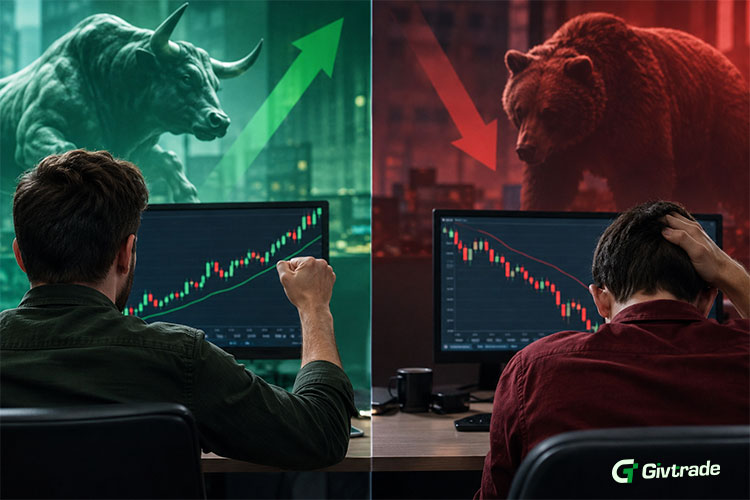
Most new traders learn one direction first: buy low, sell high. What they discover later -sometimes after months of sitting out falling markets -is that in forex and CFD trading, falling prices are just as tradeable as rising ones.
Going long means buying because you expect the price to rise. Going short means selling because you expect it to fall. The ability to profit in both directions is one of the defining advantages of CFD trading -and one of the most underused tools among new GCC traders.
Understanding how both positions work in practice, what triggers each one, and how they behave differently under market pressure is foundational knowledge that every UAE and GCC trader needs before moving into live markets.
What Is a Long Position?
A long position is opened when you buy a financial instrument expecting its price to rise. If you open a long position on EUR/USD at 1.0850 and the price rises to 1.0900, you profit from the 50-pip difference. If the price falls instead, you carry a loss until you close the position or your stop loss is triggered.
Going long is the more intuitive direction for most new traders. It mirrors how most people think about investing -you buy something, it goes up in value, you sell it for a profit. In forex and CFD trading, the mechanics are the same, but the timeframe is compressed. A long position on gold held for three hours behaves exactly like one held for three weeks in terms of how profit and loss are calculated -the only difference is the duration and the overnight swap charges that accumulate on positions held past the daily rollover.
For GCC traders, long positions on gold (XAU/USD) and oil (Brent crude) are the most common starting point. Both instruments have strong cultural familiarity in the region, and both are instruments where the fundamental case for going long -rising safe-haven demand, supply constraints, dollar weakness -is regularly covered in regional financial media and GivTrade's market reports.
What Is a Short Position?
A short position is opened when you sell a financial instrument expecting its price to fall. In traditional investing, short-selling is complex and often restricted. In CFD trading, going short is as simple as clicking sell instead of buy.
If you open a short position on EUR/USD at 1.0850 and the price falls to 1.0800, you profit from the 50-pip move downward. If the price rises instead, you carry a loss. The mechanics mirror a long position exactly -the direction of profit and loss is simply reversed.
This is the structural advantage that most new GCC traders take time to internalise. When a news event drives oil prices sharply lower -an unexpected OPEC production increase, a demand shock, a dollar surge -traders who only know how to go long can only watch. Traders who understand short positions can open a sell on Brent crude and participate in that move directly. The same applies to forex pairs, indices, metals, and any other instrument available on GivTrade's platform.
How Long and Short Positions Work Together in Practice
The real value of understanding both directions is not that you trade them simultaneously -it is that you are never limited to one market environment. Trending markets, ranging markets, and declining markets all offer tradeable setups when you can go both long and short.
A practical example most GCC traders encounter early: EUR/USD is in a clear downtrend on the daily chart, consistently making lower highs and lower lows. A trader who only goes long keeps looking for a reversal that does not come. A trader who understands short positions reads the trend correctly, opens a short at a pullback to resistance, and profits from continued downside -the setup the chart was already describing.
The economic calendar is particularly relevant here. High-impact data releases -NFP, CPI, FOMC decisions -regularly produce sharp directional moves in either direction. Traders who are comfortable going both long and short can position for the move based on their analysis, rather than hoping the market moves in the one direction they know how to trade.
The One Difference GCC Traders Need to Understand
Long and short positions behave identically in terms of how profit and loss are calculated -but they differ in one important practical way: the direction of the overnight swap charge.
When you hold a long position overnight, you either pay or receive a swap depending on the interest rate differential between the two currencies (or the financing cost of the instrument). When you hold a short position overnight, the same calculation applies but in reverse -sometimes earning a positive swap, sometimes paying. For GCC traders who prefer to avoid overnight charges entirely on either direction, GivTrade's swap-free account option is available on trading accounts and removes this variable from multi-day positions.
The GivTrade Take
The distinction between long and short is simple in theory and takes practice to apply confidently in live markets. Most GCC traders who limit themselves to long-only trading describe the same frustration: sitting through prolonged downtrends on instruments they follow closely, unable to participate because they have not built comfort with the short side.
The traders who develop genuine two-directional confidence share one habit: they practise short positions in demo trading before taking them live. Opening a short on EUR/USD on a demo account, watching how it behaves when price moves against you versus in your favour, and experiencing the P&L mechanics of a short position removes the unfamiliarity before real capital is involved. For context on how position sizing applies equally to both directions, see our guide on why most forex traders lose money in their first 90 days -the same risk management principles apply whether you are long or short.
Explore forex and CFD instruments in both directions on GivTrade and check this week's directional catalysts on the economic calendar.
Frequently Asked Questions
What does going long mean in trading?
Buying an instrument expecting its price to rise -you profit from upward price movement and lose if the price falls before you close the position.
What does going short mean in trading?
Selling an instrument expecting its price to fall -you profit from downward price movement and lose if the price rises before you close the position.
Can GCC traders go short on forex and CFDs?
Yes -in CFD trading, going short is as straightforward as going long. You click sell instead of buy on any instrument available on the platform, including forex pairs, gold, oil, indices, and shares.
Is there a difference in risk between long and short positions?
The mechanics of risk are identical in both directions. A 50-pip adverse move costs the same whether you are long or short. The key risk management tools -stop loss placement, position sizing, and margin monitoring -apply equally to both.
What is the swap charge on a short position?
Overnight swap charges on short positions are calculated in the reverse direction to long positions. Depending on the instrument and the interest rate differential, a short position can carry a positive or negative swap. GivTrade's swap-free account option removes this for both directions on qualifying instruments.
Risk Warning: Trading forex and Contracts for Difference (CFDs) on margin carries a high level of risk. Retail clients could sustain a total loss of deposited funds. This article is for informational and educational purposes only and does not constitute investment advice. GivTrade Financial Services L.L.C S.O.C, CMA licence #20200000367. GivTrade Mauritius, registration No. 197387, is authorized and regulated by the Financial Services Commission (FSC) License No. GB22201329.